I am sure we are all familiar with the term “If it’s too good to be true…it probably is.” in the world of the internet this is usually the case. I am sure that you have all seen ads or e-mails that claim to get you thousands of hits a day. The internet seems to be full of these companies that are promising large amounts of traffic at a fraction of the cost of normal PPC, but is it really worth it?
1. How can those company can bring traffic to your site?
What these companies do really depends on the method they use to get traffic.
+ Methods: Some use browser tool bars, some use spyware programs, some use instant messenger, and some even use viruses.
About toolbar: Have you ever seen a “free toolbar” or some other “free tool” that you install on your computer? That’s them and they are everywhere. Of course not all of these tools are bad but how are you supposed to know which ones are and are not spyware, its simply not possible in most cases. Because of this fact these programs spread across the internet and get hundreds of thousands of users. When user installed it, it may be works as virus/spam, automatically tracked users and browse your website. And of course, user does not know that they visit this website. The result is this traffic is bad. They can not increase sales, clicks on ads ... etc.
Another method is used: pop-up ads, pop-under ads, or even bot traffic. What this means is that if you sign up for a traffic program, your page may now have become spam. Your website would be popping up on thousands of desktops world wide to people who could not care less about your products. With bot traffic, it’s even worse in that the user may not even know they went to a website at all. Their computer automatically visits the site for them, with out them ever knowing.
I know some pop-up program can make your site be considered as spam like pop-under.ru ... You should avoid those traffic.
Now you can see why these paid traffic companies are often a bad idea, and why you should avoid them. The traffic is so cheap that many only need one sale to cover the cost, but so is its quality.
If you really want quality traffic that converts, the only way is to stick to what works. Stick to reputable companies with proven track records and always research a company before you enter into a contract with them. A simple internet search could save you hundreds of dollars and your reputation. It may take more time and cost a little more, but it’s better than the alternatives.
Showing posts with label General Knowledge. Show all posts
Showing posts with label General Knowledge. Show all posts
Friday, November 7, 2008

Saturday, November 1, 2008
Reason why make money online failed ?
Every day, there are thousands of new blogs started and thousands of people trying to make money online for the first time. Yet, how many of your friends or family do you know that are successful at it? For all the people that start out, how many of them actually succeed? I was one of those people a year ago and I so I know first hand why so many people give up.
Most people start out with good intentions to make money on the Internet probably because they have heard or read ads that promise easy money and a carefree lifestyle. What they don't realize is that those ads are just hyped up advertising that often border on outright lies. Making money with your computer online is not as easy as it is made out to be. In fact, it is downright difficult.
In order to make money online, you have to be prepared to do a tremendous amount of learning. Not only do you have to figure out what to sell but also how to sell it. You have to understand the dynamics of advertising and be able to get people interested in buying what you have to offer. In addition, you have to begin to learn a lot of technical computer and Internet related things in order to be able to set up shop.
There are many ways to earn money on the Internet but most of them ultimately involve owning a website and getting traffic and potential customers to it. This can be very daunting to someone who has little to no Internet experience. You can try to learn it all yourself as I did or you may be able to take some computer classes and cut down the learning time. Classes and paying people to teach you or do things for you can become expensive however.
Most people fail in their quest to make money online because they just give up. They learn first hand that it is not as easy as promised and that the learning curve is quite steep. If anyone can make money through the Internet, we would all be doing it and everyone would have that happy carefree life.
To be successful in most anything in life, you have to put in a lot of effort. Making money online is no different as I have discovered that I could work 16 hours a day, 7 days a week and never run out of things to do and work on. This is not what most people want to hear and when they discover that for themselves they just move on to something else.Saturday, October 25, 2008
Scams and How to avoids
Typical Scams
ENVELOPE STUFFING SCAMS
CHAIN LETTERS AND PYRAMID SCHEMES
MAIL ORDER SCAMS
MULTI-LEVEL MARKETING PROGRAMS
TELEMARKETING FRAUD
================================
ENVELOPE STUFFING SCAMS

Just about every mail order publication has at least one ad in it promising hundreds of dollars a week, just for stuffing envelopes. Some even promise to pay $4 or $5 per envelope stuffed! So, many people send off their hard earned money for the "registration fees" just to discover they have been duped.
Let's take a logical look at this type of scam.
Would you pay someone even 50 cents to stuff an envelope when you can buy an envelope stuffing machine for a few hundred dollars? So, there must be more to what you will have to do than simply stuffing an envelope.
There is more. The most prevalent envelope stuffing scam goes like this. You pay your "registration fee" - usually around $30.00. This "registration fee" is pure profit for the operator.
The operator will then send you a copy of the ad you originally responded to, along with the wording to a classified ad, telling people about how much money they can make stuffing envelopes, and to send a self-addressed stamped envelope for information. When you receive someone's SASE, you send them a copy of the ad.
You have just "stuffed an envelope". If the poor sucker sends in the registration fee to the operator (like YOU did), the operator will send you $1 (or whatever was promised in the ad) for "stuffing the envelope". The operator is left with expenses of around $2 and a profit of $28.
Basically, you are doing all the advertising work for the operator for extremely low pay. You should expect a response rate, if you're lucky, of 0.25% to 0.5%. Even at 0.5%, you would have to get 200 responses to your classified ad to earn $1.
The other most common scam goes like this. You send the usual "registration fee" in, and the operator sends you a package containing all the components of the operators mailings. You must assemble them, fold them, and stuff the envelopes according to the operator's very exact instructions.
Then, you send the stuffed envelopes back to the operator. You will be paid for each stuffed envelope that "meets their standards". Of course, none of the envelopes you stuffed will meet their standards. They will find some reason not to pay you. Of course, that doesn't prevent them from still sending out the envelopes you stuffed...
As you can see, joining an envelope stuffing program is not a good idea. Save your money and put it towards a legitimate mail order business. You will be happier and more successful.
CHAIN LETTERS AND PYRAMID SCHEMES

In case you are not familiar with them, here's an overview, so you know what to watch out for.
Chain letters are those letters you get, instructing you to send, say $5, to the 4 to 6 people on the list, who will send you a report, or some product, or sometimes even nothing. Then, you add your name to the bottom of the list, moving the others up, and the top one off.
You then print and mail out as many as you can, hoping others will do the same as you. The letters are liberally sprinkled with references to how much money you will make, and how many people are sure to participate. Some even go so far as to promise you $1,000,000 and more, sometimes in less than a month!
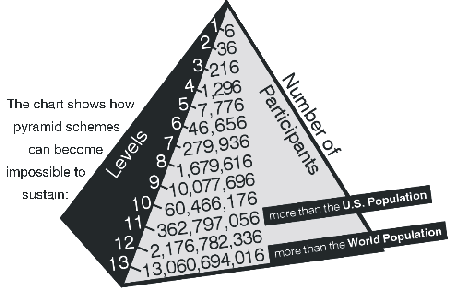
Pyramid schemes are what chain letters are based on. You buy into one, then you need to recruit others below you, to move you up the line. The people you recruit, in turn, need to recruit others, and so on. Pyramids go by all kinds of names and formats.
For example, a popular pyramid scheme goes like this: There are 8 "level 4," 4 "level 3", 2 " level 2", and 1 "level 1". When you buy in, you pay a predetermined amount, like $10, to the level 1 person. That makes you a level 4.
When you recruit 8 more people, you become a level 3. Your 8 people then need to recruit 8 more, to move you up, and so on. You're promised that you will get hundreds of dollars when you're at level 1.
These programs all share many characteristics.
They are illegal.
Don't believe what the chain letters say, that someone "showed it to the postmaster, who assured him it was legal," or "it's legal, check the postal codes."
Pyramid schemes are illegal because you're paying money for nothing, in a shaky con game which can fall apart if recruiting drops off. With a chain letter, it's the same, but it's conducted through the mail, which opens up mail fraud laws, also.
The mathematics used in the letters and schemes is flawed.
Most chain letters will say you should expect a 5% - 10% response from your mailings. As anyone in mail order will tell you, this is absurd, especially in regard to chain letters.
With a chain letter you are relying on others to do the work that will make money for you. There is no such thing as a free lunch. Somewhere along the line, people will drop out and everybody loses!
It doesn't matter if the chain letter/pyramid involves sending money, recipes, stamps, or any product or object of value. It's still ILLEGAL and a poor business proposition.
MAIL ORDER SCAMS

EXAMPLE 1
Collect names for us. We pay $20 each. Guaranteed! The truth is, this company WILL pay you $20 for each name you collect for them. What they DON'T tell you is that each person has to spend $100 or more by placing an order before you get your $20.
The customer is led to believe that all they have to do is get out their phone books and start sending the company names and addresses. In return, the company will send them $20 for each name and address they send them. When they send away for the details they discover the scam and think everybody in mail order is operating this way. Result: Mail order is labeled as a scam and illegal business activity.
EXAMPLE 2
"How to get 100,000 people to send you $5 each. Send $5 to..." This is cute advertising, but you have to put a legitimate product behind claims like this. One of the materials I found was a book with this title. And you get the book for sending $5 to the publisher. What the you find out is that you are expected to run the same ad in newspapers and tabloids. Other people will send $1 for information and their mailbox is "supposedly" flooded with $1 bills. This ad is NOT illegal. It asks you to send $1 for information and you DO get the information. It's just something you should keep in mind so your expectations aren't high.
These types of ads can be classified under the heading of a "Legitimate Scam." You can't complain that your order was not filled. You can't complain the idea is not possible. You can't complain the ad promised something it didn't deliver.
Likewise, do not confuse scam-sounding ads with legitimate "lead-generating ads". A mail order company may run an ad that states: "Want to make a lot of money? Call 1-800-999-1212". This is NOT necessarily a scam or rip-off. Since there is no cost involved it might be worth your time and effort to call the number and see what is being offered.
Some dealers run ads that don't tell you what the product is because they have an entire package of information they want to send you. It would be too costly to advertise the complete information in a small 1" or 2" ad, so they run "Lead-Generating Ads" to bring them inquiries. This is also not illegal and is common business practice. You will also find that real "Lead-Generating Ads" DON'T ask you for a lot of money up front. They only tell you enough about the product to entice you to send in a SASE (self-addressed stamped envelope) or $1 for more information. They are unlike "Example 2" which basically tells you the scam before you order it!
Instead of complaining, people should be writing their mail order publishers when they are ripped-off, providing them with documentation and a summary of these mail order scams.
Use your common sense! Get your facts straight. Have documentation to back-up your findings and submit them! Wouldn't it be nice if everybody in the world were honest?
MULTI-LEVEL MARKETING PROGRAMS

Multi-level marketing is a fancy name used by some companies in an effort to do two things.
1. To move products from their warehouses, and thus increase their sales volume.
2. To recruit "an army" of commission-only sales people.
After you've stripped all the hoopla away from these "super money-making opportunities", the bottom line remains the same - you make money from commissions allowed from the sale of products.
Generally speaking, very few people have any "real" sales experience, and thus, if offered the opportunity to take a job as a commission-only sales person, they'd run from it. Which is not always best since many companies do provide great support and free training to help you along the way.

Most commission-only sales positions are "direct selling" opportunities.
A lot of personal fortunes have been made by commission-only sales people.
When you sell by mail, you are almost always involved in commission selling, and direct selling.
BEWARE - Most people are "duped" into joining multi-level marketing programs without understanding that it is commission sales and at least a form of door-to-door selling. There are some multi-level marketing companies that subtly encourage you to break the law, and run the risk of huge monetary fines, long terms in prison, or both!
This is done by "inferring" that if you find a certain number of people to duplicate what you're doing, and in turn encourage each person to keep the system going, everybody will get rich!
That's a "Ponzi Scheme"!
A Ponzi Scheme is any kind of money-making opportunity where you get paid by recruiting, enlisting or soliciting other people to follow your lead and continue a chain of events. In other words, you'll be paid a commission from the people you recruit, from the people they recruit, from the people they recruit, and on into infinity.
This is the "secret" that most multi-level marketing companies use to induce you to buy into their program. Such practices are illegal, and subject to federal laws which could destroy you. Bi-level marketing plans are the same thing, as are chain letters, and people-helping people clubs. They are all based upon the Ponzi Scheme. If you have any doubts, take your money-making opportunity and sit down with your local postmaster and discuss it's legality.
These things are illegal because if they really worked, by the time one person had attained level number five, he would have "signed up" everybody on the face of the earth with only the first two levels receiving any of the money. There would be nobody left for the third, fourth and fifth levels to sell to.
Multi-level marketing companies get around the law by stating within their by-laws that it is strictly forbidden to promote or attempt to sell the program by mail. Then, when the postal inspectors come calling on the little guy, the MLM company says: He did it - we don't do such things - here, look at our by-laws.
To make any money selling a product or service on a commission-only basis, you have to have the ability to sell like the well known "used car salesman". It's all hard sell, and more often than not, involves "forcing" the prospect to buy whether it's good for him or not.
Anyone who has ever attempted to succeed in commission sales, knows that it takes a product in great demand - a great deal of sales calls, advertising and persistence - at least a little bit of failure - and a tremendous amount of "total business moxie" to make any money at it.
There is nothing wrong with commission selling. If you're good at it, and receive the proper training and support, you can make a lot of money, but remember that multi-level marketing is commission based. It takes a special kind of personality and a great company to succeed at it.
TELEMARKETING FRAUD

Phone fraud is a multi-billion dollar business that involves selling everything from bad or non-existent investments to the peddling of misrepresented products and services. Everyone who has a phone is a prospect. Becoming a victim is largely up to you.
1. High-pressure sales tactics.
The call may not begin that way, but if the swindler senses you're not going to be an easy sale, he or she may shift to a hard sell. This is in contrast to legitimate businesses, most of which respect an individual's right to be "not interested".
High-pressure sales tactics take a variety of forms but the common denominator is usually a stubborn reluctance to accept "no" as an answer. Some callers may resort to insult and argument, questioning the prospect's intelligence or ability to make a decision, often ending with a warning that "you're going to be very sorry if you don't do such and such". Or, "you'll never get rich if you don't take a chance".
2. Insistence on an immediate decision.
If it's an investment, the caller may say something like, "the market is starting to move even as we speak". For a product or service, the urgency pitch may be that "there are only a few left" or "the offer is about to expire". The bottom line is that swindlers often insist that you must make your decision right now. And they always give a reason why.
3. The offer sounds too good to be true.
The oldest advice around is still the best: "An offer that sounds too good to be true probably is". Be aware that some phone swindlers are becoming more sophisticated and may make statements that sound just reasonable enough (if only barely) to keep you from hanging up. They may make three or four statements you know to be true so that when they spring the big lie on you for what they're selling, you'll be more likely to believe that, too.
4. A request for your credit card number for any purpose other than to make a purchase.
A swindler may ask you for your credit card number. Or, several credit card numbers just for "identification," or "verification" that you have won something, or merely as an "expression of good faith" on your part. Whatever the ploy, once a swindler has your card number it is likely that unauthorized charges will appear on your account.
5. An offer to send someone to your home or office to pick up the money, or some other method such as overnight mail to get your funds more quickly.
This is likely to be part of their "urgency" pitch. It may actually be an effort to avoid mail fraud charges by bypassing postal authorities or simply a way of getting your money before you change your mind.
6. A statement that something is "free," followed by a requirement that you pay for something.
While honest firms may promote free phone offers to attract customers, the difference with swindlers is that you generally have to pay in some way to get whatever it is that's "free." The cost may be labeled as a handling or shipping charge, or as payment for an item in addition to the "prize". Whatever you receive "free", if anything, most likely will be worth much less than what you paid.
7. An investment that's "without risk."
Except for obligations of the U.S. Government, all investments have some degree of risk. If there were any such thing as a risk-free investment with big profits assured, the caller certainly would not have to be calling people in the phone book to find investors!
8. Unwillingness to provide written information or references (such as a bank or names of satisfied customers in your area) that you can contact.
Swindlers generally have a long list of reasons: "There isn't time for that," or "it's a brand new offer and printed material isn't available yet," or "customer references would violate their privacy". Even with references, be cautious, some swindlers actually pay some customers to serve as references.
The caller may also be reluctant to answer questions by phone -- such as inquiries about the firm or even how and where you can contact the firm. The swindler may insist on contacting you "for your convenience".
9. A suggestion that you should make a purchase or investment on the basis of "trust."
Trust should not be given indiscriminately, and certainly not to unknown persons calling on the phone and asking that you send them money. Just the same, "trust me" is a pitch that swindlers sometimes employ when all else fails.
==========================================
Now we come back to topic: How to avoid it?
1. Don't allow yourself to be pushed into a hurried decision.
No matter what you are told to the contrary, the reality is that at least 99 percent of everything that's a good deal today will still be a good deal a week from now! And the other one percent isn't generally worth the risk you would be taking to find out.
There may be times when you'll want to make a prompt decision, but those occasions shouldn't involve an irrevocable financial commitment to purchase a product or make an investment that you are not familiar with from a caller that you don't know. Also, purchase decisions should never be made under pressure.
2. Always request written information be mailed to you about the product, service, investment or charity and the organization or company offering it.
For legitimate firms, this shouldn't be a problem. Swindlers, however, may not want to give you time for adequate consideration, may not have written material available, or may not want to risk a run-in with legal or regulatory authorities by putting fraudulent statements in writing.
You should insist on having enough time to study any information provided before being contacted again or agreeing to meet with anyone in person. Some high-pressure telephone sales calls are solely for the purpose of persuading you to meet with an even higher-pressure sales person in your home!
3. Don't make any investment or purchase you don't fully understand.
Unless you fully understand what you will be buying or investing in, you can be badly burned. Swindlers intentionally seek out individuals who don't know what they are doing! They often attempt to flatter prospects into thinking they are making an informed decision.
4. Ask what state or federal agencies the firm is regulated by and is required to be registered with.
If you get an answer to this, ask for a phone number or address that you can use to contact the agency and verify the answer yourself. If the firm says it's not subject to any regulation, you may want to increase your level of caution accordingly.
5. Check out the company or organization.
If you assume a firm wouldn't provide you with information, references, or regulatory contacts unless the information was accurate and reliable, that's precisely what swindlers want you to assume. They know that most people never bother to follow through. Most victims of fraud contact a regulatory agency after they've lost their money. It is far better to make the contact and obtain whatever information is available while you still have your money.
6. If an investment or major purchase is involved, request that information also be sent to your accountant, financial advisor, banker, or attorney for evaluation and an opinion.
Swindlers don't want you to seek a second opinion. Their reluctance or evasiveness could be your tip-off.
7. Ask what recourse you would have if you make a purchase and aren't satisfied.
If there's a guarantee or refund provision, it's best to have it in writing and be satisfied that the business will stand behind its guarantee before you make a final financial commitment.
8. Beware of testimonials that you may have no way of checking out.
They may involve nothing more than someone being paid a fee to speak well of a product or service.
9. Don't provide personal financial information over the phone unless you are absolutely certain the caller has a bona fide need to know.
That goes especially for your credit card numbers and bank account information. The only time you should give anyone your credit card number is if you've decided to make a purchase and want to charge it. If someone says they'll send a bill later but they need your credit card number in the meantime, be cautious and be certain you're dealing with a reputable company.
10. If necessary, hang up.
If you're simply not interested, if you become subject to high-pressure sales tactics, if you can't obtain the information you want or get evasive answers, or if you hear your own better judgment whispering that you may be making a serious mistake, just say good-bye.
ENVELOPE STUFFING SCAMS
CHAIN LETTERS AND PYRAMID SCHEMES
MAIL ORDER SCAMS
MULTI-LEVEL MARKETING PROGRAMS
TELEMARKETING FRAUD
================================
ENVELOPE STUFFING SCAMS

Just about every mail order publication has at least one ad in it promising hundreds of dollars a week, just for stuffing envelopes. Some even promise to pay $4 or $5 per envelope stuffed! So, many people send off their hard earned money for the "registration fees" just to discover they have been duped.
Let's take a logical look at this type of scam.
Would you pay someone even 50 cents to stuff an envelope when you can buy an envelope stuffing machine for a few hundred dollars? So, there must be more to what you will have to do than simply stuffing an envelope.
There is more. The most prevalent envelope stuffing scam goes like this. You pay your "registration fee" - usually around $30.00. This "registration fee" is pure profit for the operator.
The operator will then send you a copy of the ad you originally responded to, along with the wording to a classified ad, telling people about how much money they can make stuffing envelopes, and to send a self-addressed stamped envelope for information. When you receive someone's SASE, you send them a copy of the ad.
You have just "stuffed an envelope". If the poor sucker sends in the registration fee to the operator (like YOU did), the operator will send you $1 (or whatever was promised in the ad) for "stuffing the envelope". The operator is left with expenses of around $2 and a profit of $28.
Basically, you are doing all the advertising work for the operator for extremely low pay. You should expect a response rate, if you're lucky, of 0.25% to 0.5%. Even at 0.5%, you would have to get 200 responses to your classified ad to earn $1.
The other most common scam goes like this. You send the usual "registration fee" in, and the operator sends you a package containing all the components of the operators mailings. You must assemble them, fold them, and stuff the envelopes according to the operator's very exact instructions.
Then, you send the stuffed envelopes back to the operator. You will be paid for each stuffed envelope that "meets their standards". Of course, none of the envelopes you stuffed will meet their standards. They will find some reason not to pay you. Of course, that doesn't prevent them from still sending out the envelopes you stuffed...
As you can see, joining an envelope stuffing program is not a good idea. Save your money and put it towards a legitimate mail order business. You will be happier and more successful.
CHAIN LETTERS AND PYRAMID SCHEMES

In case you are not familiar with them, here's an overview, so you know what to watch out for.
Chain letters are those letters you get, instructing you to send, say $5, to the 4 to 6 people on the list, who will send you a report, or some product, or sometimes even nothing. Then, you add your name to the bottom of the list, moving the others up, and the top one off.
You then print and mail out as many as you can, hoping others will do the same as you. The letters are liberally sprinkled with references to how much money you will make, and how many people are sure to participate. Some even go so far as to promise you $1,000,000 and more, sometimes in less than a month!
Pyramid schemes are what chain letters are based on. You buy into one, then you need to recruit others below you, to move you up the line. The people you recruit, in turn, need to recruit others, and so on. Pyramids go by all kinds of names and formats.
For example, a popular pyramid scheme goes like this: There are 8 "level 4," 4 "level 3", 2 " level 2", and 1 "level 1". When you buy in, you pay a predetermined amount, like $10, to the level 1 person. That makes you a level 4.
When you recruit 8 more people, you become a level 3. Your 8 people then need to recruit 8 more, to move you up, and so on. You're promised that you will get hundreds of dollars when you're at level 1.
These programs all share many characteristics.
They are illegal.
Don't believe what the chain letters say, that someone "showed it to the postmaster, who assured him it was legal," or "it's legal, check the postal codes."
Pyramid schemes are illegal because you're paying money for nothing, in a shaky con game which can fall apart if recruiting drops off. With a chain letter, it's the same, but it's conducted through the mail, which opens up mail fraud laws, also.
The mathematics used in the letters and schemes is flawed.
Most chain letters will say you should expect a 5% - 10% response from your mailings. As anyone in mail order will tell you, this is absurd, especially in regard to chain letters.
With a chain letter you are relying on others to do the work that will make money for you. There is no such thing as a free lunch. Somewhere along the line, people will drop out and everybody loses!
It doesn't matter if the chain letter/pyramid involves sending money, recipes, stamps, or any product or object of value. It's still ILLEGAL and a poor business proposition.
MAIL ORDER SCAMS

EXAMPLE 1
Collect names for us. We pay $20 each. Guaranteed! The truth is, this company WILL pay you $20 for each name you collect for them. What they DON'T tell you is that each person has to spend $100 or more by placing an order before you get your $20.
The customer is led to believe that all they have to do is get out their phone books and start sending the company names and addresses. In return, the company will send them $20 for each name and address they send them. When they send away for the details they discover the scam and think everybody in mail order is operating this way. Result: Mail order is labeled as a scam and illegal business activity.
EXAMPLE 2
"How to get 100,000 people to send you $5 each. Send $5 to..." This is cute advertising, but you have to put a legitimate product behind claims like this. One of the materials I found was a book with this title. And you get the book for sending $5 to the publisher. What the you find out is that you are expected to run the same ad in newspapers and tabloids. Other people will send $1 for information and their mailbox is "supposedly" flooded with $1 bills. This ad is NOT illegal. It asks you to send $1 for information and you DO get the information. It's just something you should keep in mind so your expectations aren't high.
These types of ads can be classified under the heading of a "Legitimate Scam." You can't complain that your order was not filled. You can't complain the idea is not possible. You can't complain the ad promised something it didn't deliver.
Likewise, do not confuse scam-sounding ads with legitimate "lead-generating ads". A mail order company may run an ad that states: "Want to make a lot of money? Call 1-800-999-1212". This is NOT necessarily a scam or rip-off. Since there is no cost involved it might be worth your time and effort to call the number and see what is being offered.
Some dealers run ads that don't tell you what the product is because they have an entire package of information they want to send you. It would be too costly to advertise the complete information in a small 1" or 2" ad, so they run "Lead-Generating Ads" to bring them inquiries. This is also not illegal and is common business practice. You will also find that real "Lead-Generating Ads" DON'T ask you for a lot of money up front. They only tell you enough about the product to entice you to send in a SASE (self-addressed stamped envelope) or $1 for more information. They are unlike "Example 2" which basically tells you the scam before you order it!
Instead of complaining, people should be writing their mail order publishers when they are ripped-off, providing them with documentation and a summary of these mail order scams.
Use your common sense! Get your facts straight. Have documentation to back-up your findings and submit them! Wouldn't it be nice if everybody in the world were honest?
MULTI-LEVEL MARKETING PROGRAMS

Multi-level marketing is a fancy name used by some companies in an effort to do two things.
1. To move products from their warehouses, and thus increase their sales volume.
2. To recruit "an army" of commission-only sales people.
After you've stripped all the hoopla away from these "super money-making opportunities", the bottom line remains the same - you make money from commissions allowed from the sale of products.
Generally speaking, very few people have any "real" sales experience, and thus, if offered the opportunity to take a job as a commission-only sales person, they'd run from it. Which is not always best since many companies do provide great support and free training to help you along the way.
Most commission-only sales positions are "direct selling" opportunities.
A lot of personal fortunes have been made by commission-only sales people.
When you sell by mail, you are almost always involved in commission selling, and direct selling.
BEWARE - Most people are "duped" into joining multi-level marketing programs without understanding that it is commission sales and at least a form of door-to-door selling. There are some multi-level marketing companies that subtly encourage you to break the law, and run the risk of huge monetary fines, long terms in prison, or both!
This is done by "inferring" that if you find a certain number of people to duplicate what you're doing, and in turn encourage each person to keep the system going, everybody will get rich!
That's a "Ponzi Scheme"!
A Ponzi Scheme is any kind of money-making opportunity where you get paid by recruiting, enlisting or soliciting other people to follow your lead and continue a chain of events. In other words, you'll be paid a commission from the people you recruit, from the people they recruit, from the people they recruit, and on into infinity.
This is the "secret" that most multi-level marketing companies use to induce you to buy into their program. Such practices are illegal, and subject to federal laws which could destroy you. Bi-level marketing plans are the same thing, as are chain letters, and people-helping people clubs. They are all based upon the Ponzi Scheme. If you have any doubts, take your money-making opportunity and sit down with your local postmaster and discuss it's legality.
These things are illegal because if they really worked, by the time one person had attained level number five, he would have "signed up" everybody on the face of the earth with only the first two levels receiving any of the money. There would be nobody left for the third, fourth and fifth levels to sell to.
Multi-level marketing companies get around the law by stating within their by-laws that it is strictly forbidden to promote or attempt to sell the program by mail. Then, when the postal inspectors come calling on the little guy, the MLM company says: He did it - we don't do such things - here, look at our by-laws.
To make any money selling a product or service on a commission-only basis, you have to have the ability to sell like the well known "used car salesman". It's all hard sell, and more often than not, involves "forcing" the prospect to buy whether it's good for him or not.
Anyone who has ever attempted to succeed in commission sales, knows that it takes a product in great demand - a great deal of sales calls, advertising and persistence - at least a little bit of failure - and a tremendous amount of "total business moxie" to make any money at it.
There is nothing wrong with commission selling. If you're good at it, and receive the proper training and support, you can make a lot of money, but remember that multi-level marketing is commission based. It takes a special kind of personality and a great company to succeed at it.
TELEMARKETING FRAUD

Phone fraud is a multi-billion dollar business that involves selling everything from bad or non-existent investments to the peddling of misrepresented products and services. Everyone who has a phone is a prospect. Becoming a victim is largely up to you.
1. High-pressure sales tactics.
The call may not begin that way, but if the swindler senses you're not going to be an easy sale, he or she may shift to a hard sell. This is in contrast to legitimate businesses, most of which respect an individual's right to be "not interested".
High-pressure sales tactics take a variety of forms but the common denominator is usually a stubborn reluctance to accept "no" as an answer. Some callers may resort to insult and argument, questioning the prospect's intelligence or ability to make a decision, often ending with a warning that "you're going to be very sorry if you don't do such and such". Or, "you'll never get rich if you don't take a chance".
2. Insistence on an immediate decision.
If it's an investment, the caller may say something like, "the market is starting to move even as we speak". For a product or service, the urgency pitch may be that "there are only a few left" or "the offer is about to expire". The bottom line is that swindlers often insist that you must make your decision right now. And they always give a reason why.
3. The offer sounds too good to be true.
The oldest advice around is still the best: "An offer that sounds too good to be true probably is". Be aware that some phone swindlers are becoming more sophisticated and may make statements that sound just reasonable enough (if only barely) to keep you from hanging up. They may make three or four statements you know to be true so that when they spring the big lie on you for what they're selling, you'll be more likely to believe that, too.
4. A request for your credit card number for any purpose other than to make a purchase.
A swindler may ask you for your credit card number. Or, several credit card numbers just for "identification," or "verification" that you have won something, or merely as an "expression of good faith" on your part. Whatever the ploy, once a swindler has your card number it is likely that unauthorized charges will appear on your account.
5. An offer to send someone to your home or office to pick up the money, or some other method such as overnight mail to get your funds more quickly.
This is likely to be part of their "urgency" pitch. It may actually be an effort to avoid mail fraud charges by bypassing postal authorities or simply a way of getting your money before you change your mind.
6. A statement that something is "free," followed by a requirement that you pay for something.
While honest firms may promote free phone offers to attract customers, the difference with swindlers is that you generally have to pay in some way to get whatever it is that's "free." The cost may be labeled as a handling or shipping charge, or as payment for an item in addition to the "prize". Whatever you receive "free", if anything, most likely will be worth much less than what you paid.
7. An investment that's "without risk."
Except for obligations of the U.S. Government, all investments have some degree of risk. If there were any such thing as a risk-free investment with big profits assured, the caller certainly would not have to be calling people in the phone book to find investors!
8. Unwillingness to provide written information or references (such as a bank or names of satisfied customers in your area) that you can contact.
Swindlers generally have a long list of reasons: "There isn't time for that," or "it's a brand new offer and printed material isn't available yet," or "customer references would violate their privacy". Even with references, be cautious, some swindlers actually pay some customers to serve as references.
The caller may also be reluctant to answer questions by phone -- such as inquiries about the firm or even how and where you can contact the firm. The swindler may insist on contacting you "for your convenience".
9. A suggestion that you should make a purchase or investment on the basis of "trust."
Trust should not be given indiscriminately, and certainly not to unknown persons calling on the phone and asking that you send them money. Just the same, "trust me" is a pitch that swindlers sometimes employ when all else fails.
==========================================
Now we come back to topic: How to avoid it?
1. Don't allow yourself to be pushed into a hurried decision.
No matter what you are told to the contrary, the reality is that at least 99 percent of everything that's a good deal today will still be a good deal a week from now! And the other one percent isn't generally worth the risk you would be taking to find out.
There may be times when you'll want to make a prompt decision, but those occasions shouldn't involve an irrevocable financial commitment to purchase a product or make an investment that you are not familiar with from a caller that you don't know. Also, purchase decisions should never be made under pressure.
2. Always request written information be mailed to you about the product, service, investment or charity and the organization or company offering it.
For legitimate firms, this shouldn't be a problem. Swindlers, however, may not want to give you time for adequate consideration, may not have written material available, or may not want to risk a run-in with legal or regulatory authorities by putting fraudulent statements in writing.
You should insist on having enough time to study any information provided before being contacted again or agreeing to meet with anyone in person. Some high-pressure telephone sales calls are solely for the purpose of persuading you to meet with an even higher-pressure sales person in your home!
3. Don't make any investment or purchase you don't fully understand.
Unless you fully understand what you will be buying or investing in, you can be badly burned. Swindlers intentionally seek out individuals who don't know what they are doing! They often attempt to flatter prospects into thinking they are making an informed decision.
4. Ask what state or federal agencies the firm is regulated by and is required to be registered with.
If you get an answer to this, ask for a phone number or address that you can use to contact the agency and verify the answer yourself. If the firm says it's not subject to any regulation, you may want to increase your level of caution accordingly.
5. Check out the company or organization.
If you assume a firm wouldn't provide you with information, references, or regulatory contacts unless the information was accurate and reliable, that's precisely what swindlers want you to assume. They know that most people never bother to follow through. Most victims of fraud contact a regulatory agency after they've lost their money. It is far better to make the contact and obtain whatever information is available while you still have your money.
6. If an investment or major purchase is involved, request that information also be sent to your accountant, financial advisor, banker, or attorney for evaluation and an opinion.
Swindlers don't want you to seek a second opinion. Their reluctance or evasiveness could be your tip-off.
7. Ask what recourse you would have if you make a purchase and aren't satisfied.
If there's a guarantee or refund provision, it's best to have it in writing and be satisfied that the business will stand behind its guarantee before you make a final financial commitment.
8. Beware of testimonials that you may have no way of checking out.
They may involve nothing more than someone being paid a fee to speak well of a product or service.
9. Don't provide personal financial information over the phone unless you are absolutely certain the caller has a bona fide need to know.
That goes especially for your credit card numbers and bank account information. The only time you should give anyone your credit card number is if you've decided to make a purchase and want to charge it. If someone says they'll send a bill later but they need your credit card number in the meantime, be cautious and be certain you're dealing with a reputable company.
10. If necessary, hang up.
If you're simply not interested, if you become subject to high-pressure sales tactics, if you can't obtain the information you want or get evasive answers, or if you hear your own better judgment whispering that you may be making a serious mistake, just say good-bye.
Wednesday, October 15, 2008
The first factor in MMO: Get traffic
The most important factor for a website is traffic. If it has more traffic, more people know that website ==> It will have more chance to earn money from CPM or CPA
But how does a website can get traffic? I will tell you some source to get traffic from:
1. Search engine:
Many people use search engine to find the information which they need. Therefor, it is the first traffic source you have to care. The technique to get more traffic from search engine is called SEO.
I will tell you more about it in later post. In general, you have to make your site appear in the first search page ==> You will more traffic from them.
But how does a website can get traffic? I will tell you some source to get traffic from:
1. Search engine:
Many people use search engine to find the information which they need. Therefor, it is the first traffic source you have to care. The technique to get more traffic from search engine is called SEO.
I will tell you more about it in later post. In general, you have to make your site appear in the first search page ==> You will more traffic from them.
2. Community, communication, consideration.
The three founding principals of marketing your blog to an audience, whether general, or specific. People want to get be a part of the next thing, so give them a chance.
2.1 Community
Whether you start up your own community, or join others, via means of MyBlogLog, MySpace, LinkedIn, Xing and others, this is a guaranteed and proven way to get visitors, to get hits, impressions, and often quality traffic, because you know that these people haven’t just clicked on a random link or search engine listing, but have seen you or your website’s profile, and followed it through to your homepage/landing page. The best ways to get the profiles themselves noticed? See below…
2.2 Communication
I don’t mean ’spam’ by this either. Get involved in genuine discussions, with other people of similar interests, start up a civilized, profitable, knowledgeable discussion, then when you’re finished, ask if they’d take a look at your blog or website. You’d be surprised how many loyal readers have come to my own blog in this way. Simply leave comments in communities, on social networks, on other blogs, etc.
Still not quite your way of dealing with people?
3. Considering
All the time, you have to consider the reader. Who are you writing for? The reader. Who will be navigating your blog? The reader. Who should you devote your time, energy and attention to? The reader. Consideration is important, and you can show this in many ways. Either by having a clutter-free, easy-to-follow design, or you could alternatively try getting the readers involved, by asking questions in blog posts, or website statements, and opening up comments. If people comment, strike up a conversation with them, and keep them coming back. Answer their queries and requests with solid, reliable, dependable answers, and take note of the feedback they leave by using it, and putting it into action. If someone states that your text is hard to read, change the colour to stop it clashing so much with the background, or simply make it slightly larger.
There are lots of ways you can show consideration to your audience, and it shows just how loyal you are to your readers through this. If someone spots an inaccuracy in a blog post and tells you, don’t be lazy. Go change it! They’ll keep coming back, they’ll tell their friends, and in turn this C will do word-of-mouth marketing wonders.
The Most Important Things In Make Money Online
Of all of the potential money making ideas out there on the internet, one of the absolute most popular is blogging. Some people start their blog without the intention of using it to make money, but many plan from the beginning or learn shortly thereafter, that blogging for money is relatively simple and is very achievable. When it comes to blogging for money, the main thing is to have a blog that gets traffic and good search engine rankings, but what are the three most important things when trying to make money by blogging?
1. Mental State - The most important part of successful blogging for money strategies is to have the right mental state. The blog needs to be something that the author is passionate about or otherwise he will lose interest eventually and may not be able to keep it as up to date as possible. When the author of a blog loses interest, it is hard to expect that the readers will remain interested. It is also important for the author to be creative and original when putting content on a blog.
2. Promotion - Whether a blog owner is using standard link building strategies, buying text links or banner ads, networking with other blog owners or people associated with the subject matter covered by the blog, or using any other blog promotion method, they need to understand that the importance of successfully promoting their blog. In fact, the actual methods of blog promotion that are used are not nearly as important as the fact that a great amount of effort needs to be focused on promotion in general. Without building links and promoting the blog to other sites, there will be much fewer visitors to the blog. The fewer visitors to the blog and the fewer people will want to promote their site on that blog.
3. Time Management - It doesn’t matter how passionate someone is about a subject or how much they know, if they don’t have the free time it takes to regularly update and improve their blog, then the blog will never achieve the status or success that they want it to. There are some large time demands made on the author by a blog. There needs to be time enough to write new and original content, time to advertise and build links to the blog, time improve the design and functionality of the blog, and time to handle the administrative duties associated with blogging like answering emails and comments. Again, if there is not enough time available to keep the blog up to date then it will start to look like it is an abandoned blog and there is little chance new or repeat visitors will be coming it’s way.
There is a number of different ways and methods to make money while blogging. Whether a blog owner wants to focus on selling in content links, text links, banner ads, or entire blog posts, there will be no buyers for these products unless the above three things are tackled first. A blog needs to be run by someone with the proper mental state to keep improving it, someone with the amount of time it takes to keep it properly updated, and someone with the knowledge and desire to promote their blog so that it can maximize the number of viewers or trafic that the site gets. The concept of blogging for money is not hard or difficult to understand, but the actual procedure of blogging for money does require a great deal of hard work.

1. Mental State - The most important part of successful blogging for money strategies is to have the right mental state. The blog needs to be something that the author is passionate about or otherwise he will lose interest eventually and may not be able to keep it as up to date as possible. When the author of a blog loses interest, it is hard to expect that the readers will remain interested. It is also important for the author to be creative and original when putting content on a blog.
2. Promotion - Whether a blog owner is using standard link building strategies, buying text links or banner ads, networking with other blog owners or people associated with the subject matter covered by the blog, or using any other blog promotion method, they need to understand that the importance of successfully promoting their blog. In fact, the actual methods of blog promotion that are used are not nearly as important as the fact that a great amount of effort needs to be focused on promotion in general. Without building links and promoting the blog to other sites, there will be much fewer visitors to the blog. The fewer visitors to the blog and the fewer people will want to promote their site on that blog.
3. Time Management - It doesn’t matter how passionate someone is about a subject or how much they know, if they don’t have the free time it takes to regularly update and improve their blog, then the blog will never achieve the status or success that they want it to. There are some large time demands made on the author by a blog. There needs to be time enough to write new and original content, time to advertise and build links to the blog, time improve the design and functionality of the blog, and time to handle the administrative duties associated with blogging like answering emails and comments. Again, if there is not enough time available to keep the blog up to date then it will start to look like it is an abandoned blog and there is little chance new or repeat visitors will be coming it’s way.
There is a number of different ways and methods to make money while blogging. Whether a blog owner wants to focus on selling in content links, text links, banner ads, or entire blog posts, there will be no buyers for these products unless the above three things are tackled first. A blog needs to be run by someone with the proper mental state to keep improving it, someone with the amount of time it takes to keep it properly updated, and someone with the knowledge and desire to promote their blog so that it can maximize the number of viewers or trafic that the site gets. The concept of blogging for money is not hard or difficult to understand, but the actual procedure of blogging for money does require a great deal of hard work.
Saturday, October 11, 2008
What is Cost Per Action or CPA ?
Cost Per Action or CPA (sometimes known as Pay Per Action or PPA) is an online advertising pricing model, where the advertiser pays for each specified action (a purchase, a form submission, and so on) linked to the advertisement.
Direct response advertisers consider CPA the optimal way to buy online advertising, as an advertiser only pays for the ad when the desired action has occurred. An action can be a product being purchased, a form being filled, etc. (The desired action to be performed is determined by the advertiser.) Google incorporated this model into Google AdSense [1] but shut down the offering in June 2008[2]. eBay has recently announced a similar pricing called AdContext.
The CPA can be determined by different factors, depending where the online advertising inventory is being purchased.
CPA as "Cost Per Acquisition"
CPA is sometimes referred to as "Cost Per Acquisition", which has to do with the fact that most CPA offers by advertisers are about acquiring something (typically new customers by making sales). Using the term "Cost Per Acquisition" instead of "Cost Per Action" is not incorrect. It is actually more specific. "Cost Per Acquisition" is included in "Cost Per Action", but not all "Cost Per Action" offers can be referred to as "Cost Per Acquisition".
eCPA
A related term, eCPA or effective Cost Per Action, is used to measure the effectiveness of advertising inventory purchased (by the advertiser) via a CPC, CPM, or CPT basis.
eCPA is used to measure the effectiveness of advertising inventory purchased (by the advertiser) via a CPC, CPI, or CPT basis. In other words, the eCPA tells the advertiser what they would have paid if they purchased the advertising inventory on a CPA basis (instead of a CPC, CPM, or CPT basis).
Good company provide CPA program:
* Google started testing CPA on 2006. On June 2007 Google expanded its beta trial, opening it to users of AdWords
* eBay has moved into CPA advertising with its AdContext system on 2006
* Snap.com, CPA pioneer and later merged with other to form NBC Internet (NBCi), has long touted the advantages of the CPA model, such as the elimination of click fraud.
* ViralyticsMedia.com, Created the first CPA e-mail marketing network in the Fall of 2007..
* Jellyfish.com was the Internet's first comparison shopping search engine to operate exclusively on a Cost Per Action (CPA) ad model, has a patent pending on an improvement over CPA where part of the ad revenue goes to the customer, and has been bought by Microsoft for integration into Live Search.
* Hydra, LLC launched the first-ever exclusive, fully transparent CPA network, called Hydra Elite in 2008.
Direct response advertisers consider CPA the optimal way to buy online advertising, as an advertiser only pays for the ad when the desired action has occurred. An action can be a product being purchased, a form being filled, etc. (The desired action to be performed is determined by the advertiser.) Google incorporated this model into Google AdSense [1] but shut down the offering in June 2008[2]. eBay has recently announced a similar pricing called AdContext.
The CPA can be determined by different factors, depending where the online advertising inventory is being purchased.
CPA as "Cost Per Acquisition"
CPA is sometimes referred to as "Cost Per Acquisition", which has to do with the fact that most CPA offers by advertisers are about acquiring something (typically new customers by making sales). Using the term "Cost Per Acquisition" instead of "Cost Per Action" is not incorrect. It is actually more specific. "Cost Per Acquisition" is included in "Cost Per Action", but not all "Cost Per Action" offers can be referred to as "Cost Per Acquisition".
eCPA
A related term, eCPA or effective Cost Per Action, is used to measure the effectiveness of advertising inventory purchased (by the advertiser) via a CPC, CPM, or CPT basis.
eCPA is used to measure the effectiveness of advertising inventory purchased (by the advertiser) via a CPC, CPI, or CPT basis. In other words, the eCPA tells the advertiser what they would have paid if they purchased the advertising inventory on a CPA basis (instead of a CPC, CPM, or CPT basis).
Good company provide CPA program:
* Google started testing CPA on 2006. On June 2007 Google expanded its beta trial, opening it to users of AdWords
* eBay has moved into CPA advertising with its AdContext system on 2006
* Snap.com, CPA pioneer and later merged with other to form NBC Internet (NBCi), has long touted the advantages of the CPA model, such as the elimination of click fraud.
* ViralyticsMedia.com, Created the first CPA e-mail marketing network in the Fall of 2007..
* Jellyfish.com was the Internet's first comparison shopping search engine to operate exclusively on a Cost Per Action (CPA) ad model, has a patent pending on an improvement over CPA where part of the ad revenue goes to the customer, and has been bought by Microsoft for integration into Live Search.
* Hydra, LLC launched the first-ever exclusive, fully transparent CPA network, called Hydra Elite in 2008.
List of good CPM program
AdsDaq (no requirement) - While they only provide CPM ads to specific countries, their ability to display backup ads from any network makes them an easy first choice for somebody looking to test the waters of the CPM market.
Ad Dynamix - (no requirement) - While not quite as intuitive as AdsDaq, their minimal requirements make Ad Dynamix quite approachable even though their customer support is poor.
ValueClick (3,000 pageviews per month) - While their pageview requirements are quite low, ValueClick is known to be picky with the type of site they will approve.
Morning Falls (10,000 pageviews per month) - A relatively low traffic requirement, solid customer service, simple implementation and easy to understand reports make this a good CPM publisher for beginners.
CPX Interactive (10,000 pageviews per month) - A relatively new face on the advertising scene, CPX Interactive offers good integration and solid reporting. Meeting the traffic requirements is not always good enough, however, as their internal approval process is on the strict side.
Burst Media (20,000 pageviews per month) - Burst Media is an intermediate advertising publisher. Their overly-complicated integration and reports, as well as their poor customer service hold them back from the upper echelon of advertising networks.
Casale Media (10,000 unique visitors per month) - A good intermediate ad publisher, perfect for an established site that has not quite reached A-List status just yet. Casale Media handles larger sites as well, making them a good long-term choice for many sites.
Tribal Fusion (60,000 unique visitors per month) - A solid pay scale, depending on your niche. Tribal Fusion represents hundreds of sites with a wide range of categories.
Brightroll (100,000 video views and 250,000 pageviews per month) - Along with Video Egg, Brightroll is the only other advertising publisher on this list that is truly centered on new media. Their video view requirement automatically puts them in the advanced category.
Adtegrity (500,000 pageviews per month) - While their orange and green color scheme may make you scratch your head, Adtegrity is known for their quality customer service and is quickly becoming a leader in the advertising network field.
Advertising.com (2 million pageviews per month) - One of the heavy hitters of online ad publishing, their high pageview entry point means only well-established sites need apply.
Video Egg (10 million video views per month) - The cream of the new media crop, Video Egg concentrates entirely on advertising in online videos.
What is CPM advertising?
What is CPM advertising?
CPM is an acronym for Cost Per Thousand -- the "M" in CPM derives from the Latin "mille" for "thousand." CPM is commonly used in marketing as a benchmark to calculate the relative cost of an advertising campaign or an ad message. Rather than an absolute cost, CPM estimates the cost per 1000 views of the ad.
It is calculated by:
Total budget / (Impressions/1000) = CPM
Although cost-per-click, or CPC, advertising is enjoying great popularity, CPM (cost per thousand impressions) advertising is still an effective way of reaching potential customers on the Web. Instead of paying per click, in a CPM campaign you purchase a set amount of impressions.
CPM-based advertising can be a cost-effective alternative to CPC deals. To illustrate this point, let's compare the overall expense of two similar campaigns.
In CPC-based advertising, you pay for each click your ad receives. Let us say that you are spending $1 for each click; 10 clicks costs you $10.
In a CPM-based campaign, you may pay $3 for 1,000 impressions. If your ad receives a click-through ratio of just 1 percent, you're paying $3 for the same 10 clicks.
Current results have shown that text-based CPM ads often receive more attention that traditional banner ads. In fact, the average view time for a text based ad averaged 7 seconds, while a graphical ad only averaged 1.6 seconds. Text CPM ads are starting to become more popular and may be a viable alternative to CPC-based advertising.
http://make-money-earn-money-online.blogspot.com/2008/10/list-of-good-cpm-program.html
CPM is an acronym for Cost Per Thousand -- the "M" in CPM derives from the Latin "mille" for "thousand." CPM is commonly used in marketing as a benchmark to calculate the relative cost of an advertising campaign or an ad message. Rather than an absolute cost, CPM estimates the cost per 1000 views of the ad.
It is calculated by:
Total budget / (Impressions/1000) = CPM
Although cost-per-click, or CPC, advertising is enjoying great popularity, CPM (cost per thousand impressions) advertising is still an effective way of reaching potential customers on the Web. Instead of paying per click, in a CPM campaign you purchase a set amount of impressions.
CPM-based advertising can be a cost-effective alternative to CPC deals. To illustrate this point, let's compare the overall expense of two similar campaigns.
In CPC-based advertising, you pay for each click your ad receives. Let us say that you are spending $1 for each click; 10 clicks costs you $10.
In a CPM-based campaign, you may pay $3 for 1,000 impressions. If your ad receives a click-through ratio of just 1 percent, you're paying $3 for the same 10 clicks.
Current results have shown that text-based CPM ads often receive more attention that traditional banner ads. In fact, the average view time for a text based ad averaged 7 seconds, while a graphical ad only averaged 1.6 seconds. Text CPM ads are starting to become more popular and may be a viable alternative to CPC-based advertising.
CPM-based advertising may be more suited for your company if your desired keywords are very popular and expensive. Instead of paying $5 for a single click, you could but 1,000 ad impressions. This can add up over time.
Although click-through ratios for CPM-based advertising are low, click-throughs aren't everything. Even an unclicked (but viewed) ad can play an important role in promoting your company. A well-designed ad will catch a viewer’s eye and may promote brand recognition, even if the viewer doesn't click.
Targeted CPM-based advertising is also beginning to catch on, which may even the playing field for advertisers looking for a CPC alternative. If you can display your ad to a targeted audience, your click-through ratios will improve.
Many sites offer targeted CPM-based advertising options, and you should be able to find a service that will mesh well with your company’s offerings. Targeted advertising greatly increases overall effectiveness of your ads, and the addition of CPM-based targeted advertising may be a great benefit to many small companies.
The downside to CPM-based advertising is that the minimum purchase of impressions could be more than your company requires. While $5 per thousand impressions is very appealing, a minimum purchase of one million impressions can quickly scare off many businesses.
However, there are companies that offer low minimums, and it pays to do your homework before selecting a company that requires the advance purchase of a large amount of impressions.
If your budget allows for it, test several different methods of advertising at the same time and track the results. This way you can see which method is best suited for your particular company and gives you the best value for your advertising dollar.
See next posts for list of CPM programhttp://make-money-earn-money-online.blogspot.com/2008/10/list-of-good-cpm-program.html
How is a site rank by google pagerank?
Google PageRank: What Do We Know About It?
Summary: How Does PageRank Work?
1. PageRank is only one of numerous methods Google uses to determine a page’s relevance or importance.
2. Google interprets a link from page A to page B as a vote, by page A, for page B. Google looks not only at the sheer volume of votes; among 100 other aspects it also analyzes the page that casts the vote. However, these aspects don’t count, when PageRank is calculated.
3. PageRank is based on incoming links, but not just on the number of them - relevance and quality are important (in terms of the PageRank of sites, which link to a given site).
4. PR(A) = (1-d) + d(PR(t1)/C(t1) + … + PR(tn)/C(tn)). That’s the equation that calculates a page’s PageRank.
5. Not all links weight the same when it comes to PR.
6. If you had a web page with a PR8 and had 1 link on it, the site linked to would get a fair amount of PR value. But, if you had 100 links on that page, each individual link would only get a fraction of the value.
7. Bad incoming links don’t have impact on Page Rank.
8. Ranking popularity considers site age, backlink relevancy and backlink duration. PageRank doesn’t.
9. Content is not taken into account when PageRank is calculated.
10. PageRank does not rank web sites as a whole, but is determined for each page individually.
11. Each inbound link is important to the overall total. Except banned sites, which don’t count.
12. PageRank values don’t range from 0 to 10. PageRank is a floating-point number.
13. Each Page Rank level is progressively harder to reach. PageRank is believed to be calculated on a logarithmic scale.
14. Google calculates pages PRs permanently, but we see the update once every few months (Google Toolbar).
Summary: Impact on Google PageRank
1. Frequent content updates don’t improve Page Rank automatically. Content is not part of the PR calculation.
2. High Page Rank doesn’t mean high search ranking.
3. DMOZ and Yahoo! Listings don’t improve Page Rank automatically.
4. .edu and .gov-sites don’t improve Page Rank automatically.
5. Sub-directories don’t necessarily have a lower Page Rank than root-directories.
6. Wikipedia links don’t improve PageRank automatically (update: but pages which extract information from Wikipedia might improve PageRank).
7. Links marked with nofollow-attribute don’t contribute to Google PageRank.
8. Efficient internal onsite linking has an impact on PageRank.
9. Related high ranked web-sites count stronger. But: “a page with high PageRank may actually pass you less if it has more links, because it’s spread too thin.” [RY]
10. Links from and to high quality related sites have an impact on Page Rank.
11. Multiple votes to one link from the same page cost as much as a single vote.
1.1. What is PageRank?
* “PageRank is one of the methods Google uses to determine a page’s relevance or importance.”
* “Google uses many factors in ranking. Of these, the PageRank algorithm might be the best known. PageRank evaluates two things: how many links there are to a web page from other pages, and the quality of the linking sites. With PageRank, five or six high-quality links from websites such as www.cnn.com and www.nytimes.com would be valued much more highly than twice as many links from less reputable or established sites.”
* “PageRank has only ever been an approximation of the quality of a web page and has never had anything to do with the measuring of the topical relevance of a web page. Topical relevance is measured with link context and on-page factors such as keyword density, title tag, and everything else.”
1.2. How Does PageRank work?
* No one really knows.“No one knows for sure how PageRank is currently calculated by Google.”
* PR(A) = (1-d) + d(PR(t1)/C(t1) + … + PR(tn)/C(tn)). “That’s the equation that calculates a page’s PageRank. In the equation ‘t1 - tn’ are pages linking to page A, ‘C’ is the number of outbound links that a page has and ‘d’ is a damping factor, usually set to 0.85.”
* We can think of it in a simpler way: a page’s PageRank = 0.15 + 0.85 * (a “share” of the PageRank of every page that links to it). “share” = the linking page’s PageRank divided by the number of outbound links on the page. A page “votes” an amount of PageRank onto each page that it links to. The amount of PageRank that it has to vote with is a little less than its own PageRank value (its own value * 0.85). This value is shared equally between all the pages that it links to.”
* “The core Google PageRank algorithm “distributes” it’s established PR across all of the outbound links. Put differently, if you had a web page with a PR8 and had 1 link on it, the site linked to would get a fair amount of PR value. But, if you had 100 links on that page, each individual link would only get a fraction of the value.”
* “From this, we could conclude that a link from a page with PR4 and 5 outbound links is worth more than a link from a page with PR8 and 100 outbound links. The PageRank of a page that links to yours is important but the number of links on that page is also important. The more links there are on a page, the less PageRank value your page will receive from it.”
* “PageRank [..] uses the link structure as an indicator of an individual page’s value. Google interprets a link from page A to page B as a vote, by page A, for page B. Google looks at considerably more than the sheer volume of votes, or links a page receives; e.g. it also analyzes the page that casts the vote. Votes cast by pages that are themselves “important” weigh more heavily and help to make other pages “important.”
* “Not all links weight the same when it comes to PR. So an ‘important’ page linking to you gives you more PR than a ‘less important’ one. […] A factor in PR propagation is the number of out-links the ‘voting’ page have. So a PR4 page with only one out-link on it might give you more weight than a PR5 page with 100 out-links on it. A typical example here would be the famous milliondollarhomepage. This page is PR7 page with hunderds of out-links therefore its weight is would contribute very little to your page PR.”
* Each Page Rank level is progressively harder to reach. “PageRank is logarithmic in its calculation. In the same way that the earthquake Richter scale is exponential in calculation, so too is the mathematics behind Google PageRank. It takes one step to move from a PR0 to a PR1, it takes a few more steps to PR3, it takes even more steps to PR4, and many more steps again to PR5, and so one.”
Google PageRank Explained
* “PageRank does not rank web sites as a whole, but is determined for each page individually. Further, the PageRank of page A is recursively defined by the PageRanks of those pages which link to page A.”
* “Google combines PageRank with sophisticated text-matching techniques to find pages that are both important and relevant to user’s search. Google examines all aspects of the page’s content (and the content of the pages linking to it) to determine if it’s a good match for user’s queries.”
* “Google calculates pages PRs once every few months (PR update). After a PR update is done, all pages are assigned a new PR by Google and you will have this PR until a new PR update is done. New sites that were just launched will have a PR of 0 until an update is done by Google so that they are assigned an appropriate PR.”
* “Google PageRank is calculated all the time, but what we see in the Google Toolbar (or other online PR tools) is a snapshot in time which is updated every 3 months or so.”
* PageRank values don’t range from 0 to 10. PageRank is a floating-point number. “It’s more accurate to think of it as a floating-point number. Certainly our internal PageRank computations have many more degrees of resolution than the 0-10 values shown in the toolbar.”
* “We’re sure that their curve is similar to an exponential curve with each new “plateau” being harder to reach than the last. I have personally done some research into this, and so far the results point to an exponential base of 4. So a PR of 6 is 4 times as difficult to attain as a PR of 5. [..] The difference between a high PR of 6, and a low PR of 6, could be hundreds or thousands of links.”
* “PageRank is believed to be calculated on a logarithmic scale. What this roughly means is that the difference between PR4 and PR5 is likely 5-10 times than the difference between PR3 and PR4. So, there are likely over a 100 times as many web pages with a PageRank of 2 than there are with a PageRank of 4. This means that if you get to a PageRank of 6 or so, you’re likely well into the top 0.1% of all websites out there. If most of your peer group is straggling around with a PR2 or PR3, you’re way ahead of the game.”
* “The fact is that PageRank is based on incoming links, but not just on the number of them. Instead PageRank is based on the value of your incoming links. To find the value of an incoming link look at the PR of the source page, and divide it by the number of links on that page. It’s very possible to get a PR of 6 or 7 from only a handful of incoming links if your links are “weighty” enough.”
* “Google tries to find pages that are both reputable and relevant. If two pages appear to have roughly the same amount of information matching a given query, we’ll usually try to pick the page that more trusted websites have chosen to link to. Still, we’ll often elevate a page with fewer links or lower PageRank if other signals suggest that the page is more relevant. For example, a web page dedicated entirely to the civil war is often more useful than an article that mentions the civil war in passing, even if the article is part of a reputable site such as Time.com.”
* Links don’t give PR away, they are votes. “When a page votes its PageRank value to other pages, its own PageRank is not reduced by the value that it is voting. The page doing the voting doesn’t give away its PageRank and end up with nothing. It isn’t a transfer of PageRank. It is simply a vote according to the page’s PageRank value.”
* “We know from the paper “The Anatomy of a Large-Scale Hypertextual Web Search Engine” (Paper) that the PageRank of a Web page is a number calculated using a recursive algorithm in which the page receives a share of the PageRank of each page that links to it.”
* Crawlers don’t analyze web-sites permanently. “It often takes two full monthly updates for all of your incoming links to be discovered, counted, calculated and displayed as backlinks.”
1.3. Which factors do have an impact on PageRank?
* Each inbound link is important to the overall total. Except banned sites. “PageRank is a form of a voting system. A link to a page is a vote for that page. Higher PageRank pages are viewed by Google as more important. Their votes are given more value by Google — much more value, in some cases. In general, the more voting links, the stronger the PageRank.”
* Adding new pages can decrease Page Rank. “The effect is that, whilst the total PageRank in the site is increased, one or more of the existing pages will suffer a PageRank loss due to the new page making gains. Up to a point, the more new pages that are added, the greater is the loss to the existing pages. With large sites, this effect is unlikely to be noticed but, with smaller ones, it probably would.”
* Page Rank can decrease. “You can lose some important links that are no longer linking to your site. PR loss can also occur if some of your linking partners also experience a drop in their own PR, possibly setting off a chain reaction of lower PageRank all through the immediate linking network.”
* Links from and to high quality related sites are important. “The more closely related the pages, the higher the PageRank amount transferred.” “Linking to high quality sites shows the search engines your site is very useful to your visitors. Unless your site has been around for years and is well established and trusted by Google, this factor will have an adverse effect on your site’s overall ranking. Linking only to high quality content sites will give your site an edge over your competition.”
* Incoming Links from popular sites are important. If pages linking to you have a high PageRank then your page gains some part of their reputation.
* Site can be banned if it links to banned sites. “Be extremely careful of any out-going links from your site. Don’t link to bad neighborhoods (link farms, banned sites, etc.) Google will penalize you for bad links so always check the PageRank of the sites you’re linking to from your site.”
* Illegal activities will penalize your PageRank and possibly ban your site from Google. “Hidden text, deceptive redirects, cloaking, automated link exchanges, or anything else against Google’s quality guidelines” can ban your site from Google.
* Myth: the higher your google PageRank, the better the results. “While pages with a higher PageRank do tend to rank better, it is perfectly normal for a site to appear higher in the results listings even though it has a lower PageRank than competing pages. [..] Google examines the context of your incoming links, and only those links that relate to the specific keyword being searched on will help you achieve a higher ranking for that keyword.”
* Related high ranked web-sites count stronger (or don’t they?). “One-way inbound links from websites with topics that are related to your website’s topic will help you gain a higher Page Rank.” Other one-way inbound links from pages with high page rank but unrelated topics do help a little, but not nearly as much.
* Different pages from a site can have different Page Rank. “Search engines crawl and index webpages not websites, that is why your page rank may vary from page to page within your website.”
1.4. Which factors don’t have an impact on PageRank?
* Frequent content updates don’t improve PR automatically.” Although Google might send crawlers more frequently to analyze your site, what is more significant are links pointing to you.
* “Content is not taken into account when PageRank is calculated. Content is taken into account when you actually perform a search for specific search terms.”
* “High PageRank does NOT guarantee a high search ranking for any particular term. If it did, then PR10 sites like Adobe would always show up for any search you do. They don’t.”
* Google considers site age, backlink relevancy and backlink duration. PageRank doesn’t. If backlink isn’t relevant, it won’t weight much.
* Wikipedia Links don’t improve Page Rank. “Wikipedia implemented a no-follow rule, indicating that outbound links should not be followed by search engine spiders.”
* Listing in DMOZ and Yahoo! doesn’t give your site a special PR Bonus. “Google uses Open Directory Project (DMOZ.org), to power its directory. Coupling that fact with the observation that sites listed in DMOZ often get decent and inexplicable PageRank boosts, has lead many to conclude that Google gives a special bonus to sites listed in DMOZ. This is simply not true. The only bonus gained from being in DMOZ is the same bonus a site would achieve from being linked to by any other site.” However, DMOZ data is used by hundreds of sites.”
* Sub-directories don’t necessarily have a lower Page Rank than root-directories. Depending on the popularity of a web-site your subdirectories can have a higher PageRank than the root pages.
* Meta-Tags don’t improve PageRank. “Google can sometimes use the meta description tag to create an abstract for your site, so it may be useful to you if your home page is primarily composed of graphics. However, do not expect it to increase your rank.”
* .edu and .gov-sites do not provide higher PageRank (or do they?).“We don’t really have much in the way to say “Oh this is a link from the ODP, or .gov, or .edu, so give that some sort of special boost.” Its just those sites tend to have higher PageRank because-because more people link to them and reputable people link to them.”
No Follow Treatment
* Links marked with nofollow-attribute don’t contribute to Google PageRank. “Google implemented a new value, “nofollow”, for the rel attribute of HTML link and anchor elements, so that website builders and bloggers can make links that Google will not consider for the purposes of PageRank — they are links that no longer constitute a “vote” in the PageRank system.”
* Multiple votes to one link from the same page cost as much as a single vote. “It is reasonable to assume that a page can cast only one vote for another page, and that additional votes for the same page are not counted.”
* Links from one page to itself don’t improve Page Rank. “It is reasonable to assume that a page can’t vote for itself, and that such links are not counted.”
* Bad incoming links don’t have impact on Page Rank. “Where the links come from doesn’t matter. Sites are not penalized because of where the links come from.”
* Dangling links don’t have impact on Page Rank. “Dangling links are simply links that point to any page with no outgoing links. They affect the model because it is not clear where their weight should be distributed, and there are a large number of them. Because dangling links do not affect the ranking of any other page directly, we simply remove them from the system until all the PageRanks are calculated. After all the PageRanks are calculated they can be added back in without affecting things significantly.”
1.5. Ranking Factors (related to PageRank)
* Efficient internal onsite linking is important. “Internal linking is important to your overall ranking. Make sure your linking structure is easy for the spiders to crawl. Most suggest a simple hierarchy with links no more than three clicks away from your home/index page. Creating traffic modes or clusters of related links within a section on your site has proven very effective.”
* Anchor text is important. The more specific is the reference, the better Google can evaluate it and consider it in relates search queries.
* Google penalizes link farms. “Google is only concerned with pages of over 100 outgoing links. Google considers overly linked pages to be link farms, and they are penalized as such.”
* Headers (h1, … ,h6), strong tags and semantic content are important. (Update: But it doesn’t improve PageRank.) “Place it in the description and meta tags, place it in bold/strong tags, but keep your content readable and useful. Be aware of the text surrounding your keywords, search engines will become more semantic in the coming years so context is important.”
* “The anchor text of a link is often far more important than whether it’s on a high PageRank page.”
* “If you really want to know what are the most important, relevant pages to get links from, forget PageRank. Think search rank. Search for the words you’d like to rank for. See what pages come up tops in Google. Those are the most important and relevant pages you want to seek links from. That’s because Google is explicitly telling you that on the topic you searched for, these are the best.”
Summary: How Does PageRank Work?
1. PageRank is only one of numerous methods Google uses to determine a page’s relevance or importance.
2. Google interprets a link from page A to page B as a vote, by page A, for page B. Google looks not only at the sheer volume of votes; among 100 other aspects it also analyzes the page that casts the vote. However, these aspects don’t count, when PageRank is calculated.
3. PageRank is based on incoming links, but not just on the number of them - relevance and quality are important (in terms of the PageRank of sites, which link to a given site).
4. PR(A) = (1-d) + d(PR(t1)/C(t1) + … + PR(tn)/C(tn)). That’s the equation that calculates a page’s PageRank.
5. Not all links weight the same when it comes to PR.
6. If you had a web page with a PR8 and had 1 link on it, the site linked to would get a fair amount of PR value. But, if you had 100 links on that page, each individual link would only get a fraction of the value.
7. Bad incoming links don’t have impact on Page Rank.
8. Ranking popularity considers site age, backlink relevancy and backlink duration. PageRank doesn’t.
9. Content is not taken into account when PageRank is calculated.
10. PageRank does not rank web sites as a whole, but is determined for each page individually.
11. Each inbound link is important to the overall total. Except banned sites, which don’t count.
12. PageRank values don’t range from 0 to 10. PageRank is a floating-point number.
13. Each Page Rank level is progressively harder to reach. PageRank is believed to be calculated on a logarithmic scale.
14. Google calculates pages PRs permanently, but we see the update once every few months (Google Toolbar).
Summary: Impact on Google PageRank
1. Frequent content updates don’t improve Page Rank automatically. Content is not part of the PR calculation.
2. High Page Rank doesn’t mean high search ranking.
3. DMOZ and Yahoo! Listings don’t improve Page Rank automatically.
4. .edu and .gov-sites don’t improve Page Rank automatically.
5. Sub-directories don’t necessarily have a lower Page Rank than root-directories.
6. Wikipedia links don’t improve PageRank automatically (update: but pages which extract information from Wikipedia might improve PageRank).
7. Links marked with nofollow-attribute don’t contribute to Google PageRank.
8. Efficient internal onsite linking has an impact on PageRank.
9. Related high ranked web-sites count stronger. But: “a page with high PageRank may actually pass you less if it has more links, because it’s spread too thin.” [RY]
10. Links from and to high quality related sites have an impact on Page Rank.
11. Multiple votes to one link from the same page cost as much as a single vote.
1.1. What is PageRank?
* “PageRank is one of the methods Google uses to determine a page’s relevance or importance.”
* “Google uses many factors in ranking. Of these, the PageRank algorithm might be the best known. PageRank evaluates two things: how many links there are to a web page from other pages, and the quality of the linking sites. With PageRank, five or six high-quality links from websites such as www.cnn.com and www.nytimes.com would be valued much more highly than twice as many links from less reputable or established sites.”
* “PageRank has only ever been an approximation of the quality of a web page and has never had anything to do with the measuring of the topical relevance of a web page. Topical relevance is measured with link context and on-page factors such as keyword density, title tag, and everything else.”
1.2. How Does PageRank work?
* No one really knows.“No one knows for sure how PageRank is currently calculated by Google.”
* PR(A) = (1-d) + d(PR(t1)/C(t1) + … + PR(tn)/C(tn)). “That’s the equation that calculates a page’s PageRank. In the equation ‘t1 - tn’ are pages linking to page A, ‘C’ is the number of outbound links that a page has and ‘d’ is a damping factor, usually set to 0.85.”
* We can think of it in a simpler way: a page’s PageRank = 0.15 + 0.85 * (a “share” of the PageRank of every page that links to it). “share” = the linking page’s PageRank divided by the number of outbound links on the page. A page “votes” an amount of PageRank onto each page that it links to. The amount of PageRank that it has to vote with is a little less than its own PageRank value (its own value * 0.85). This value is shared equally between all the pages that it links to.”
* “The core Google PageRank algorithm “distributes” it’s established PR across all of the outbound links. Put differently, if you had a web page with a PR8 and had 1 link on it, the site linked to would get a fair amount of PR value. But, if you had 100 links on that page, each individual link would only get a fraction of the value.”
* “From this, we could conclude that a link from a page with PR4 and 5 outbound links is worth more than a link from a page with PR8 and 100 outbound links. The PageRank of a page that links to yours is important but the number of links on that page is also important. The more links there are on a page, the less PageRank value your page will receive from it.”
* “PageRank [..] uses the link structure as an indicator of an individual page’s value. Google interprets a link from page A to page B as a vote, by page A, for page B. Google looks at considerably more than the sheer volume of votes, or links a page receives; e.g. it also analyzes the page that casts the vote. Votes cast by pages that are themselves “important” weigh more heavily and help to make other pages “important.”
* “Not all links weight the same when it comes to PR. So an ‘important’ page linking to you gives you more PR than a ‘less important’ one. […] A factor in PR propagation is the number of out-links the ‘voting’ page have. So a PR4 page with only one out-link on it might give you more weight than a PR5 page with 100 out-links on it. A typical example here would be the famous milliondollarhomepage. This page is PR7 page with hunderds of out-links therefore its weight is would contribute very little to your page PR.”
* Each Page Rank level is progressively harder to reach. “PageRank is logarithmic in its calculation. In the same way that the earthquake Richter scale is exponential in calculation, so too is the mathematics behind Google PageRank. It takes one step to move from a PR0 to a PR1, it takes a few more steps to PR3, it takes even more steps to PR4, and many more steps again to PR5, and so one.”
Google PageRank Explained
* “PageRank does not rank web sites as a whole, but is determined for each page individually. Further, the PageRank of page A is recursively defined by the PageRanks of those pages which link to page A.”
* “Google combines PageRank with sophisticated text-matching techniques to find pages that are both important and relevant to user’s search. Google examines all aspects of the page’s content (and the content of the pages linking to it) to determine if it’s a good match for user’s queries.”
* “Google calculates pages PRs once every few months (PR update). After a PR update is done, all pages are assigned a new PR by Google and you will have this PR until a new PR update is done. New sites that were just launched will have a PR of 0 until an update is done by Google so that they are assigned an appropriate PR.”
* “Google PageRank is calculated all the time, but what we see in the Google Toolbar (or other online PR tools) is a snapshot in time which is updated every 3 months or so.”
* PageRank values don’t range from 0 to 10. PageRank is a floating-point number. “It’s more accurate to think of it as a floating-point number. Certainly our internal PageRank computations have many more degrees of resolution than the 0-10 values shown in the toolbar.”
* “We’re sure that their curve is similar to an exponential curve with each new “plateau” being harder to reach than the last. I have personally done some research into this, and so far the results point to an exponential base of 4. So a PR of 6 is 4 times as difficult to attain as a PR of 5. [..] The difference between a high PR of 6, and a low PR of 6, could be hundreds or thousands of links.”
* “PageRank is believed to be calculated on a logarithmic scale. What this roughly means is that the difference between PR4 and PR5 is likely 5-10 times than the difference between PR3 and PR4. So, there are likely over a 100 times as many web pages with a PageRank of 2 than there are with a PageRank of 4. This means that if you get to a PageRank of 6 or so, you’re likely well into the top 0.1% of all websites out there. If most of your peer group is straggling around with a PR2 or PR3, you’re way ahead of the game.”
* “The fact is that PageRank is based on incoming links, but not just on the number of them. Instead PageRank is based on the value of your incoming links. To find the value of an incoming link look at the PR of the source page, and divide it by the number of links on that page. It’s very possible to get a PR of 6 or 7 from only a handful of incoming links if your links are “weighty” enough.”
* “Google tries to find pages that are both reputable and relevant. If two pages appear to have roughly the same amount of information matching a given query, we’ll usually try to pick the page that more trusted websites have chosen to link to. Still, we’ll often elevate a page with fewer links or lower PageRank if other signals suggest that the page is more relevant. For example, a web page dedicated entirely to the civil war is often more useful than an article that mentions the civil war in passing, even if the article is part of a reputable site such as Time.com.”
* Links don’t give PR away, they are votes. “When a page votes its PageRank value to other pages, its own PageRank is not reduced by the value that it is voting. The page doing the voting doesn’t give away its PageRank and end up with nothing. It isn’t a transfer of PageRank. It is simply a vote according to the page’s PageRank value.”
* “We know from the paper “The Anatomy of a Large-Scale Hypertextual Web Search Engine” (Paper) that the PageRank of a Web page is a number calculated using a recursive algorithm in which the page receives a share of the PageRank of each page that links to it.”
* Crawlers don’t analyze web-sites permanently. “It often takes two full monthly updates for all of your incoming links to be discovered, counted, calculated and displayed as backlinks.”
1.3. Which factors do have an impact on PageRank?
* Each inbound link is important to the overall total. Except banned sites. “PageRank is a form of a voting system. A link to a page is a vote for that page. Higher PageRank pages are viewed by Google as more important. Their votes are given more value by Google — much more value, in some cases. In general, the more voting links, the stronger the PageRank.”
* Adding new pages can decrease Page Rank. “The effect is that, whilst the total PageRank in the site is increased, one or more of the existing pages will suffer a PageRank loss due to the new page making gains. Up to a point, the more new pages that are added, the greater is the loss to the existing pages. With large sites, this effect is unlikely to be noticed but, with smaller ones, it probably would.”
* Page Rank can decrease. “You can lose some important links that are no longer linking to your site. PR loss can also occur if some of your linking partners also experience a drop in their own PR, possibly setting off a chain reaction of lower PageRank all through the immediate linking network.”
* Links from and to high quality related sites are important. “The more closely related the pages, the higher the PageRank amount transferred.” “Linking to high quality sites shows the search engines your site is very useful to your visitors. Unless your site has been around for years and is well established and trusted by Google, this factor will have an adverse effect on your site’s overall ranking. Linking only to high quality content sites will give your site an edge over your competition.”
* Incoming Links from popular sites are important. If pages linking to you have a high PageRank then your page gains some part of their reputation.
* Site can be banned if it links to banned sites. “Be extremely careful of any out-going links from your site. Don’t link to bad neighborhoods (link farms, banned sites, etc.) Google will penalize you for bad links so always check the PageRank of the sites you’re linking to from your site.”
* Illegal activities will penalize your PageRank and possibly ban your site from Google. “Hidden text, deceptive redirects, cloaking, automated link exchanges, or anything else against Google’s quality guidelines” can ban your site from Google.
* Myth: the higher your google PageRank, the better the results. “While pages with a higher PageRank do tend to rank better, it is perfectly normal for a site to appear higher in the results listings even though it has a lower PageRank than competing pages. [..] Google examines the context of your incoming links, and only those links that relate to the specific keyword being searched on will help you achieve a higher ranking for that keyword.”
* Related high ranked web-sites count stronger (or don’t they?). “One-way inbound links from websites with topics that are related to your website’s topic will help you gain a higher Page Rank.” Other one-way inbound links from pages with high page rank but unrelated topics do help a little, but not nearly as much.
* Different pages from a site can have different Page Rank. “Search engines crawl and index webpages not websites, that is why your page rank may vary from page to page within your website.”
1.4. Which factors don’t have an impact on PageRank?
* Frequent content updates don’t improve PR automatically.” Although Google might send crawlers more frequently to analyze your site, what is more significant are links pointing to you.
* “Content is not taken into account when PageRank is calculated. Content is taken into account when you actually perform a search for specific search terms.”
* “High PageRank does NOT guarantee a high search ranking for any particular term. If it did, then PR10 sites like Adobe would always show up for any search you do. They don’t.”
* Google considers site age, backlink relevancy and backlink duration. PageRank doesn’t. If backlink isn’t relevant, it won’t weight much.
* Wikipedia Links don’t improve Page Rank. “Wikipedia implemented a no-follow rule, indicating that outbound links should not be followed by search engine spiders.”
* Listing in DMOZ and Yahoo! doesn’t give your site a special PR Bonus. “Google uses Open Directory Project (DMOZ.org), to power its directory. Coupling that fact with the observation that sites listed in DMOZ often get decent and inexplicable PageRank boosts, has lead many to conclude that Google gives a special bonus to sites listed in DMOZ. This is simply not true. The only bonus gained from being in DMOZ is the same bonus a site would achieve from being linked to by any other site.” However, DMOZ data is used by hundreds of sites.”
* Sub-directories don’t necessarily have a lower Page Rank than root-directories. Depending on the popularity of a web-site your subdirectories can have a higher PageRank than the root pages.
* Meta-Tags don’t improve PageRank. “Google can sometimes use the meta description tag to create an abstract for your site, so it may be useful to you if your home page is primarily composed of graphics. However, do not expect it to increase your rank.”
* .edu and .gov-sites do not provide higher PageRank (or do they?).“We don’t really have much in the way to say “Oh this is a link from the ODP, or .gov, or .edu, so give that some sort of special boost.” Its just those sites tend to have higher PageRank because-because more people link to them and reputable people link to them.”
No Follow Treatment
* Links marked with nofollow-attribute don’t contribute to Google PageRank. “Google implemented a new value, “nofollow”, for the rel attribute of HTML link and anchor elements, so that website builders and bloggers can make links that Google will not consider for the purposes of PageRank — they are links that no longer constitute a “vote” in the PageRank system.”
* Multiple votes to one link from the same page cost as much as a single vote. “It is reasonable to assume that a page can cast only one vote for another page, and that additional votes for the same page are not counted.”
* Links from one page to itself don’t improve Page Rank. “It is reasonable to assume that a page can’t vote for itself, and that such links are not counted.”
* Bad incoming links don’t have impact on Page Rank. “Where the links come from doesn’t matter. Sites are not penalized because of where the links come from.”
* Dangling links don’t have impact on Page Rank. “Dangling links are simply links that point to any page with no outgoing links. They affect the model because it is not clear where their weight should be distributed, and there are a large number of them. Because dangling links do not affect the ranking of any other page directly, we simply remove them from the system until all the PageRanks are calculated. After all the PageRanks are calculated they can be added back in without affecting things significantly.”
1.5. Ranking Factors (related to PageRank)
* Efficient internal onsite linking is important. “Internal linking is important to your overall ranking. Make sure your linking structure is easy for the spiders to crawl. Most suggest a simple hierarchy with links no more than three clicks away from your home/index page. Creating traffic modes or clusters of related links within a section on your site has proven very effective.”
* Anchor text is important. The more specific is the reference, the better Google can evaluate it and consider it in relates search queries.
* Google penalizes link farms. “Google is only concerned with pages of over 100 outgoing links. Google considers overly linked pages to be link farms, and they are penalized as such.”
* Headers (h1, … ,h6), strong tags and semantic content are important. (Update: But it doesn’t improve PageRank.) “Place it in the description and meta tags, place it in bold/strong tags, but keep your content readable and useful. Be aware of the text surrounding your keywords, search engines will become more semantic in the coming years so context is important.”
* “The anchor text of a link is often far more important than whether it’s on a high PageRank page.”
* “If you really want to know what are the most important, relevant pages to get links from, forget PageRank. Think search rank. Search for the words you’d like to rank for. See what pages come up tops in Google. Those are the most important and relevant pages you want to seek links from. That’s because Google is explicitly telling you that on the topic you searched for, these are the best.”
What is another good program like google adsense to get money from?
Aside from Google, other contextual advertising sites where you can earn money include
Yahoo! Publishing Network (currently in beta and available to US publishers only) http://publisher.yahoo.com/
Intellixt http://vibrantmedia.com/site/web_01a5.ht...
Quigo Adsonar http://www.quigo.com/adsonarexchange.htm
IndustryBrains http://www.industrybrains.com
Commission Junction Evolution http://www.cj.com
Kanoodle Brightads http://www.kanoodle.com/about/brightads....
Clicksor http://www.clicksor.com/affiliate_progra...
Contextweb http://www.contextweb.com/
Bidclix http://www.bidclix.com/
Bidvertiser http://www.bidvertiser.com/
I suggest you also consider joining an advertising network. Advertising networks are organizations that aggregate Web sites that offer advertising space, and sell banner ads (and other advertising options) across them. Traffic requirement is often a minimum of 5,000 monthly impressions, although many do not accept sites hosted by free page services.
Burst Media http://www.burstmedia.com
Fastclick (ValueClick). http://www.fastclick.com
Advertising.com. http://www.advertising.com
Tribal Fusion http://www.tribalfusion.com
You can also join Affiliate Programs where you sell other people's products that your audience may be interested in; and you get a certain commission after the desired action was done (whether a sale, a lead, subscription to email newsletter, or however this is defined)
Commission Junction http://www.cj.com
Linkshare http://www.linkshare.com
Yahoo! Publishing Network (currently in beta and available to US publishers only) http://publisher.yahoo.com/
Intellixt http://vibrantmedia.com/site/web_01a5.ht...
Quigo Adsonar http://www.quigo.com/adsonarexchange.htm
IndustryBrains http://www.industrybrains.com
Commission Junction Evolution http://www.cj.com
Kanoodle Brightads http://www.kanoodle.com/about/brightads....
Clicksor http://www.clicksor.com/affiliate_progra...
Contextweb http://www.contextweb.com/
Bidclix http://www.bidclix.com/
Bidvertiser http://www.bidvertiser.com/
I suggest you also consider joining an advertising network. Advertising networks are organizations that aggregate Web sites that offer advertising space, and sell banner ads (and other advertising options) across them. Traffic requirement is often a minimum of 5,000 monthly impressions, although many do not accept sites hosted by free page services.
Burst Media http://www.burstmedia.com
Fastclick (ValueClick). http://www.fastclick.com
Advertising.com. http://www.advertising.com
Tribal Fusion http://www.tribalfusion.com
You can also join Affiliate Programs where you sell other people's products that your audience may be interested in; and you get a certain commission after the desired action was done (whether a sale, a lead, subscription to email newsletter, or however this is defined)
Commission Junction http://www.cj.com
Linkshare http://www.linkshare.com
How many ways to make money with your website?
There are several lists with “ways to make money with a website” on the Internet, but none of them seem to be complete. That is why I decided to create this one. If you know a method that is not listed below, just let us know and we’ll update it.

Notice that ways to make money with a website are different from ways to make more money from it. Methods to increase your traffic or click-through rate will help you make more money, but they do not represent a method of making money per se.
For example, one could suggest that blending AdSense ads with the content is a way to make money from a website. In reality it’s not; it’s just a way to make more money by improving your ad click-through rate. The real monetization method behind it is a PPC ad network.
The list is divided into direct and indirect methods, and examples and links are provided for each point. Enjoy!
Direct Methods
1. PPC Advertising Networks
Google AdSense is the most popular option under this category, but there are also others. Basically you need to sign up with the network and paste some code snippets on your website. The network will then serve contextual ads (either text or images) relevant to your website, and you will earn a certain amount of money for every click.
The profitability of PPC advertising depends on the general traffic levels of the website and, most importantly, on the click-through rate (CTR) and cost per click (CPC). The CTR depends on the design of the website. Ads placed abode the fold or blended with content, for instance, tend to get higher CTRs. The CPC, on the other hand, depends on the nice of the website. Mortgages, financial products and college education are examples of profitable niches (clicks worth a couple of dollars are not rare), while tech-related topics tend to receive a smaller CPC (sometimes as low as a couple of cents per click).
The source of the traffic can also affect the overall CTR rate. Organic traffic (the one that comes from search engines) tends to perform well because these visitors were already looking for something, and they tend to click on ads more often. Social media traffic, on the other hand, presents terribly low CTRs because these visitors are tech-savvy and they just ignore ads.
List of popular CPC advertising networks:
2. CPM Advertising Networks
CPM advertising networks behave pretty much as PPC networks, except that you get paid according to the number of impressions (i.e., page views) that the ads displayed on your site will generate. CPM stands for Cost per Mille, and it refers to the cost for 1,000 impressions.
A blog that generates 100,000 page views monthly displaying an advertising banner with a $1 CPM, therefore, will earn $100 monthly.
CPM rates vary with the network, the position of the ad and the format. The better the network, the higher the CPM rate (because they have access to more advertisers). The closer you put the ad to the top of the page, the higher the CPM. The bigger the format (in terms of pixels), the higher the CPM.
You can get as low as $0,10 and as high as $10 per 1,000 impressions (more in some special cases). CPM advertising tends to work well on websites with a high page views per visitor ratio (e.g., online forums, magazines and so on).
List of popular CPM advertising networks:
3. Direct Banner Advertising
Selling your own advertising space is one of the most lucrative monetization methods. First and foremost because it enables you to cut out the middleman commissions and to determine your own rates. The most popular banner formats on the web are the 728×90 leaderboard, the 120×600 skyscraper, the 300×250 rectangle and the 125×125 button.
The downside of direct banner advertising is that you need to have a big audience to get qualified advertisers, and you will need to spend time managing the sales process, the banners and the payments.
Related links:
- How to Find Advertisers for Your Website
- Finding Advertisers for Your Blog
- Direct Advertising Sales for Beginners
- Openads Ad Server
- OIO Publisher Ad Platform
4. Text Link Ads
After Google declared that sites selling text links without the nofollow tag would be penalized, this monetization method became less popular.
Many website owners are still using text links to monetize their sites, though, some using the nofollow tag and some not.
The advantage of this method is that it is not intrusive. One can sell text links directly through his website or use specialized networks like Text-Link-Ads and Text-Link-Brokers to automate the process.
Text link marketplaces and networks:
5. Affiliate Marketing
Affiliate marketing is a very popular practice on the Internet. Under this system you have a merchant that is willing to let other people (the affiliates) sell directly or indirectly its products and services, in exchange for a commission. Sometimes this type of advertising is also called CPA (cost per action) or CPL (cost per lead) based.
Affiliates can send potential customers to the merchant using several tools, from banners to text links and product reviews.
In order to find suitable affiliate programs you can turn to individual companies and publishers like Dreamhost and SEOBook, or join affiliate marketplaces and networks.
List of popular affiliate marketplaces and networks:
6. Monetization Widgets
The latest trend on the web are widgets that let you monetize your website. Examples include Widgetbucks and SmartLinks. Some of these services operate under a PPC scheme, others behave like text link ads, others yet leverage affiliate links.
Their main differentiator, however, is the fact that they work as web widgets, making it easier for the user to plug and play the service on its website.
List of companies that provide monetization widgets:
7. Sponsored Reviews
PayPerPost pioneered this model, with much controversy on the beginning (related to the fact that they did not require disclosure on paid posts). Soon other companies followed, most notably Sponsored Reviews and ReviewMe, refining the process and expanding the paid blogging model.
Joining one of these sponsored reviews marketplaces will give you the opportunity to write sponsored posts on a wide range of topics. Not all bloggers are willing to get paid to write about a specific product or website (because it might compromise the editorial credibility), but the ones who do are making good money out of it.
If your blog has a big audience you could also offer sponsored reviews directly, cutting off the commissions of the middleman.
List of sponsored reviews and paid blogging networks:
8. RSS Feed Ads
With the quick adoption of the RSS technology by millions of Internet users, website owners are starting to find ways to monetize this new content distribution channel.
Feedburber already has its own publisher network, and you can sign-up to start displaying CPM based advertising on your feed footer. Bidvertiser recently introduced a RSS feed ad option as well, with a PPC scheme.
Finally, some blogs are also opting to sell banners or sponsored messages on their feed directly. John Chow and Marketing Pilgrim are two examples.
Related links:
9. Sponsors for Single Columns or Events
If you website has specific columns or events (e.g., a weekly podcast, an interview series, a monthly survey, a special project) you could find companies to sponsor them individually.
This method increases the monetization options for website owner, while giving advertisers the possibility to target a more specific audience and with a reduced commitment.
Mashable illustrates the case well. They have several advertising options on the site, including the possibility to sponsor specific columns and articles, including the “Daily Poll” and the “Web 2.0 Invites.”
Problogger also runs group writing projects occasionally, and before proceeding he publicly announce the project asking for sponsors.
10.Premium Content
Some websites and blogs give away part of their content for free, and charge for access to the premium content and exclusive tools.
SEOMoz is a good example. They have a very popular blog that gives advice and information on wide range of SEO related topics. On top of that visitors can decide to become premium members. It costs $48 monthly and it grants them access to guides, tools and other exclusive material.
11. Private Forums
While the Internet is populated with free forums, there is also the possibility to create a private one where members need to pay a single or recurring fee to join.
SEO Blackhat charges $100 monthly from its members, and they have thousands of them. Obviously in order to charge such a price for a forum membership you need to provide real value for the members (e.g., secret techniques, tools, and so on).
Performancing also launched a private forum recently, focused on the networking aspect. It is called The Hive, and the monthly cost is $10.
These are just two examples. There are many possibilities to create a private and profitable forum, you just need to find an appealing angle that will make it worth for the members.
List of popular forum software:
12. Job Boards
All the popular blogs are trying to leverage job boards to make some extra income. Guy Kawasaki, ReadWriteWeb, Problogger… you name it.
Needless to say that in order to create an active and profitable job board you need first to have a blog focused on a specific niche, and a decent amount traffic.
The advantage of this method is that it is passive. Once you have the structure in place, the job listings will come naturally, and you can charge anywhere from $10 up to $100 for each.
List of popular job board software:
13. Marketplaces
Sitepoint is the online marketplace by excellence. Some websites and blogs, however, are trying to replicate that model on a smaller scale.
Depending on your niche, a market place that allows your visitors to buy, sell and trade products could work well. Over the time you could start charging a small fee for new product listings.
The problem with this method is that there are no standard software on the web, so you would need to hire a coder to get a marketplace integrated into your website.
You can see an example of a marketplaces being used on EasyWordpress and on Mashable.
14. Paid Surveys and Polls
There are services that will pay you money to run a small survey or poll on your website. The most popular one is called Vizu Answers.
Basically you need to sign up with them, and select the kind of polls that you want to run your site. Most of these services operate under a CPM model.
15. Selling or Renting Internal Pages
Million Dollar Wiki made this concept popular, but it was being used on the web for a long time around (check Pagerank10.co.uk for instance).
These websites sell for a single fee or rent for a recurring fee internal pages on their domain. Usually they have either high Pagerak or high traffic, so that people purchasing a page will be able to benefit in some way.
Implementing this method on a small blog would be difficult, but the concept is interesting and could be explored further.
16. Highlighted Posts from Sponsors
Techmeme probably pioneered this idea, but somehow it has not spread to other websites. The tech news aggregator displays editorial posts on the left column, and on the sidebar they have a section titled “Techmeme Sponsor Posts.”
On that section posts from the blog of the advertisers get highlighted, sending qualified traffic their way. Considering that the monthly cost for one spot is $5000 and that they have around 6 sponsors at any given time, it must be working well.
17. Donations
Placing a “Donate” link or button on a website can be an efficient way to earn money, especially if your blog is on a niche where readers learn and gain value from your content.
Personal development and productivity blogs, for instance, tend to perform well with donation based systems (one good example being Steve Pavlina).
A small variation of this method appeared sometime ago with the Buy Me a Beer plugin. This WordPress plugin enables you to insert a customized message at the bottom of each article, asking the readers to chip in for a beer or coffee.
18. In-text Adverting
In-text adverting networks like Kontera and Vibrant Media will place sponsored links inside your text. These links come with a double underline to differentiate them from normal links, and once the user rolls the mouse over the link the advertising will pop. Should the user click on it the site owner will make some money.
Some people make good money with this method, but others refrain from using it due to its intrusiveness. It is also interesting to note that very few mainstream websites have experimented with in-text advertising.
19. Pop-ups and Pop-unders
Pop-ups are a common yet annoying form of advertising on the Internet. If you are just trying to make a much money as possible from your website, you could experiment with them.
If you are trying to grow the traffic and generate loyal visitors, however, you probably should stay away from them. Just consider the hundreds of pop-up blockers out there: there is a reason why they are so popular.
Ad networks that use pop-ups:
20. Audio Ads
Also called PPP (Pay Per Play), this advertising method was introduce by Net Audio Ads. the concept is pretty simple: play a small audio advertising (usually 5 seconds) every time a visitor enters into your website. The user should not be able to stop it, creating a 100% conversion rate based on unique visitors.
The company is still rolling tests, but some users are reporting to get from a $4 to a $6 CPM. Regardless of the pay rate, though, this is a very intrusive form of advertising, so think twice before using it.
21. Selling the Website
Selling your website could be your last resource, but it has the potential to generate a big sum of money in a short period of time.
Market places on online forums like DigitalPoint and Sitepoint are always active with website buyers and sellers. Keep in mind that they most used parameter to determine the value of a website is the monthly revenue that it generates, multiplied by a certain number (the multiplier can be anything from 5 to 30, depending on the expectations of the seller, on the quality of the site, on the niche and other factors).
Some people also make money trading and flipping websites. They either create them from scratch or buy existing ones, and after some revamping they sell them for a profit.
Common method to make money online: Google Adsense
Google adsense is the common way publisher used to make money online
You should know some common terms:
1. Google Adsense: What is it?
Adsense is Google’s advertising program that enables webmasters from all over the world to make money from their websites without selling any products of their own. Any website owner can apply to join the Adsense program.
Google Adsense Publisher: We are publisher if we agree to place google ads to our website.
3. What is Advertiser?
Advertiser: Pay to google to place ads to others website
4. What program google provide to us?

You should know some common terms:
1. Google Adsense: What is it?
Adsense is Google’s advertising program that enables webmasters from all over the world to make money from their websites without selling any products of their own. Any website owner can apply to join the Adsense program.
When you establish a website or a blog, you will create content relevant to your subject. Once you join the Adsense program, Google places text and image advertisements that relate to your content and your geographical area on your site. When a visitor clicks on an ad, the website owner gets a share of the revenue generated by the ad’s placement.
Google’s Adsense program has created a massive free, home based business opportunity for thousands of ordinary folks. You can sign up for the Adsense program right now if you have a website.
2. What is Publisher?Google Adsense Publisher: We are publisher if we agree to place google ads to our website.
3. What is Advertiser?
Advertiser: Pay to google to place ads to others website
4. What program google provide to us?
- AdSense for content automatically crawls the content of your pages and delivers ads (you can choose both text or image ads) that are relevant to your audience and your site content, ads so well matched, in fact, that your readers will actually find them useful.
- AdSense for search allows website publishers to provide Google web and site search to their visitors and to earn money by displaying Google ads on the search results pages.

-
AdSense for mobile content - Have a mobile website? AdSense can help you earn money from your content with a simple, integrated solution.
Get started here.
Why to chose "Make mone online"?
Many people dream of getting out of the rat race, of creating abundance and freedom and really having the life of their dreams. Many people long for the freedom that having their own business and creating their own life will bring them.
But how many actually do it?
There are a millions of excuses, millions of reasons why this won’t work, or they can’t try that, just as there are millions of people who dream of getting more out of life.
Are you the type who goes for your dreams or are you the type who is content to sit on the sidelines of life?
We live in one of the most abundant times in all of history. There is more opportunities to make money and live your dreams than ever before. You can choose to believe that or not. The believing or not is your choice but the fact of the matter is that there are more millionaires in the world today than ever before. We have information and resources literally at our fingertips. We can create whatever we want in our lives as everything we need is out there. We just need to step up and start using what is available for us.
There are many people out there that are making a great living by marketing on the Internet. The Internet offers us opportunities that we never seen in the past. Many Internet marketers started way back at the beginning. They learned the new rules and they learned what it takes, they learned about the massive and quick changes that are just a part of the new medium and most importantly for their own dreams of success, they learned to make money.
But what if you don’t have that knowledge yet? Is there a chance for you?
Well, the fact of the matter is that there is a wonderful opportunity for people who are willing to take a chance on life, to learn and work and actually take responsibility for creating the life of their dreams. If you are ready to grab hold of the dreams that you have, there is a wonderful opportunity for you out there right now. It’s called “My Internet Business” and it offers a real turnkey system that can teach you how you can market on the Internet and create your own life of freedom, abundance and prosperity.
My Internet Business is set up on a two tier Multi level marketing plan. In other words, you help others succeed and you are rewarded in return.
If you dream of a better life, of creating abundance and freedom, if you still dream of creating the life that you know in your heart can be yours, My Internet Business may be the opportunity for you.
What is behind of making money online
Which ever way you seem to surf these days, it seems that everybody on the Internet cannot possibly have time to breath, because they are all busy making cash online. Fast. Every day we all receive zillions of spam emails, all claiming to either help us pay of our mortgage in two weeks, enlarge the size of our various organs, or help some despotic dictator move funds around from one off-shore bank to another. Even the slowest, most dim witted of us should by now have realised that all these things, legal or otherwise, are simply mechanisms for making money.
The thought of crosses many of our minds on a regular basis: If all these people are generating cash on the Internet for what appears a minimal outlay, could I please have a slice of the pie? Well you can't. Not very easily. You see, the fundamental problem is that those people who already have slices of the pie are not terribly willing to let you have any.
I know I ought to have a "proper" blog for writting this off-topic material - but I cant be phaffed at the moment, so I will stick it in here for now! I am not selling anything here: I'm just expressing my opinion.
Can you make money online?
Many methods of making money online on the Internet require a continuous and inexhaustible supply of stupid people. These stupid people pay money to the clever people. Now, the world has virtually limitless supplies of dim people. Recent estimates are around the 4 billion mark. However, only a finite number of these are likely to give up their money to Mr Pie Slice Owner on any given day. Those clever people who are taking the money off the stupid people are, unsurprisingly, very good at it. So good in fact, that the monumental effort for a relative newcommer to get up to their standard is borderline prohibitive. It just aint worth the effort unless you are very good at it.
 |
The other side effect is that many of the methods of taking cash off stupid people are either vaguely illegal, or just downright very illegal. However, as you are taking the money from stupid people, you can happily work on the principle that they are too dumb to notice. Not. People have spent serious amount of time in Jail for this sort of thing.
So, keeping on the right side of the law, can you make online money on the Internet without going to great effort or dangerous risk? Possibly. The virtually guaranteed way to make money on the Internet is to have a fantastic idea, one which nobody else has ever had. Things like that kid who sold lots of pixels on a webpage. Because it was original (and had oodles of novelty value) he made a Lot of Money (TM). You have probably spotted the obvious flaw here. Clever ideas of that nature come along very rarely.
The other problem of having a cunning flash of inspiration is that it is almost 99.99% guaranteed that somebody else will have already though of it. And exploited it. The nth degree. Once any cash making scheme is devised is very rapidly reaches the point where only the best in the field make a profit any more.
Please note, I am not affilated with any of the silly schemes and rip-off ebooks available out there: I am just somebody in a position to look at these things in a holistic manner. I've certainly never "got rich quick" and I don't expect to either. I'm just passing along my thoughts on the subject.
Subscribe to:
Posts (Atom)

 Posts
Posts

